Need advice? Let's talk.
Get straightforward guidance from your broadcasting partner. Schedule a call to chat with the team about your radio station.
Book DemoFM vs Online Radio: A 2026 Strategic Comparison for Broadcasters
Is FM still worth it in 2026? Compare the costs of terrestrial towers vs. cloud broadcasting and discover how to scale your station globally.


Broadcasting is currently navigating a significant structural shift. For decades, the FM tower served as the symbol of community authority and commercial reach. However, the economic and operational landscape supporting terrestrial transmission is changing as we move through the 21st Century. Station owners now face a crossroads due to volatile industrial energy prices, a scarcity of specialized RF engineers, and the rigid nature of traditional spectrum licensing.
According to recent industry reports, digital and online platforms are now overtaking traditional analogue FM in total listening hours for the first time. The choice to maintain a physical transmitter or migrate to a cloud-based digital model is a fundamental question of long-term sustainability. FM provides a nostalgic connection to a local area, but online radio offers a lean, global, and data-driven alternative that removes the heavy lifting of needing physical infrastructure. This breakdown evaluates the general costs of ownership across hardware and growth potential for both independent community projects and enterprise-level networks.
The Infrastructure of FM: A Utility Challenge
Operating a terrestrial station is a feat of civil engineering. You act as a utility manager responsible for a complex chain of hardware that must remain powered and cooled 24 hours a day.
1. The Energy Burden
Transmitters are notoriously inefficient. To push a signal across a 20-mile radius, a station must consume a massive amount of electricity. In 2026, energy costs for high-voltage sites have become a dominant line item. Unlike a web server that scales resources based on actual traffic, an FM transmitter draws maximum power regardless of whether one person is listening or ten thousand. For a small 100W to 500W transmitter, the annual power bill can represent a significant portion of the operating budget.
2. Physical Site Management
Most stations do not own the land their towers sit on. They rely on site rental agreements with telecommunications companies or local authorities. These contracts often include annual escalations and strict requirements for equipment housing. You pay for the privilege of a hilltop or a tall building, and that real estate comes at a premium. Furthermore, you must maintain a climate-controlled environment for your exciters and processors to prevent overheating. This adds further to HVAC and electricity costs.
3. The Hardware Cycle
FM hardware involves significant upfront investment. A professional-grade transmitter, antenna array, and the necessary audio processing rack are major capital expenditures. Beyond the initial purchase, there is the inevitable hardware cycle. Capacitors fail, lightning strikes damage antennas, and cooling fans seize. In a terrestrial setup, equipment failure often results in silence unless you invest in costly redundant systems.
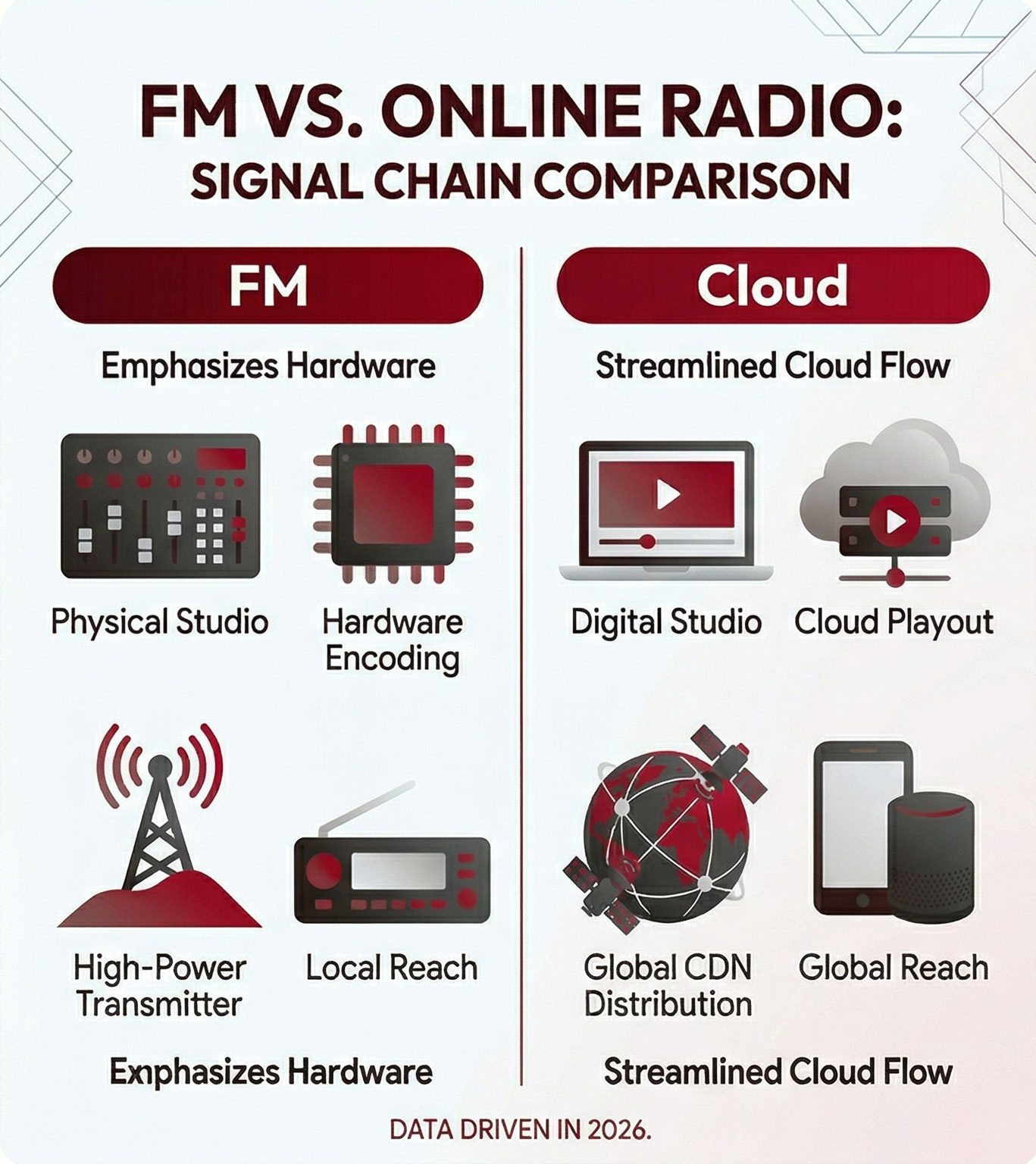
The Shift to Cloud-Based Broadcasting
Transitioning to a cloud-based model changes a station from a hardware-dependent business to a service-based one. Technical management moves from a local rack room to professional data centers, which allows teams to focus entirely on programming.
1. Decoupling from the Transmitter
In a digital-first model, the transmitter is a cloud server. You no longer need to worry about the efficiency of an RF power amplifier or the integrity of a coaxial cable. The only local energy draw is your studio equipment, such as professional microphones, a mixing desk, and a standard internet connection. This shift can reduce a station’s physical footprint and energy consumption by over 80%.
2. Built-in Redundancy
One of the most significant advantages of a cloud platform is the inherent reliability. If a local studio loses power or a home internet connection drops, a terrestrial station typically goes off-air. In a cloud environment, the playout continues. Scheduled tracks, station IDs, and segments remain active on the server to ensure listeners never experience dead air. For those interested in how these systems operate, you can learn how to start your radio station using our modern interface.
3. Operational Flexibility
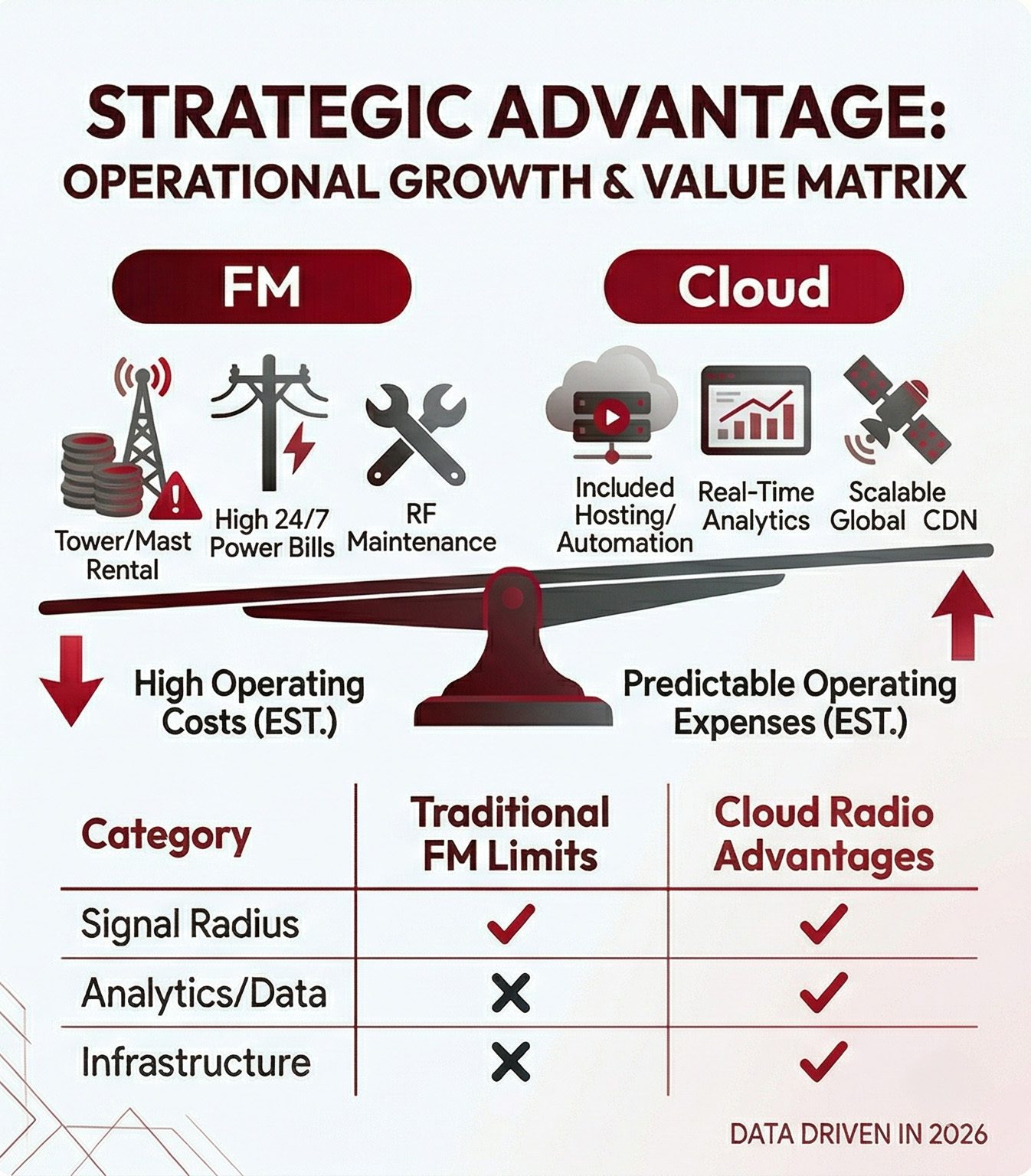
The financial model of online radio is built on predictable operating expenses, which allows station managers to budget with precision. You do not have to wait for the next expensive part to break. Instead, you pay for a managed service that includes software updates, security patches, and distribution.
Comparative Estimates: At a Glance
The following table provides a generalized comparison of the annual resources required for a standard local broadcast versus a cloud-based digital station.
Category | Terrestrial FM Station (Annual Estimate) | Online Cloud Station (Annual Estimate) |
Transmission Energy | High: Constant draw 24/7 | Negligible: Only studio power |
Tower / Site Rental | Variable based on height & location | None: Hosted in the cloud |
Maintenance | Requires specialized RF engineers | Managed by the software provider |
Hardware Refresh | Significant CAPEX every 5-7 years | Included in service updates |
Redundancy | Requires duplicate local hardware | Built into the server architecture |
Reach | Geographic limit (Line of sight) | Global by default |
Scaling Audience Without Scaling Costs
One of the primary limitations of FM broadcasting is the signal ceiling. Once you reach the edge of a licensed coverage area, audience growth stops. Reaching a neighboring town requires a new license, another transmitter, and another tower site.
Online radio removes these geographic barriers. Whether you have 10 listeners in your local neighborhood or 10,000 spread across multiple continents, the infrastructure remains the same. This scalability is vital for modern stations tapping into niche markets. If you run a specialized genre station, your true audience is the global community of enthusiasts rather than just those within a 30-mile radius. In fact, our round-up of the best online radio stations shows that niche content often performs better on a global stage than broad local content.
The Data Advantage: Strategic Programming
For a long time, FM radio operated with limited feedback. Station managers relied on quarterly surveys and statistical modelling to guess their audience size. In 2026, advertisers and sponsors increasingly demand hard data.
Digital broadcasting provides real-time analytics. You can see exactly how many people are listening at any given time, where they are located, and which device they are using. This level of insight allows you to:
- Optimize Programming: If you notice a listener drop-off during a specific segment, you can adjust content immediately.
- Demonstrate Value: You can show a sponsor exactly how many unique listeners heard their message, which facilitates more accurate valuation of airtime.
- Target Growth: If data shows a surge of listeners in a specific city, you can tailor marketing or social media efforts to that region.
The Hybrid Path: A Graceful Transition
Transitioning from FM to online can be a gradual process. Many heritage stations and enterprise networks find success with a hybrid approach. They continue to broadcast on FM to serve an existing local demographic while simultaneously building their digital presence via custom mobile apps and smart speaker skills.
By simulcasting the signal, you begin the process of migrating your audience. You can use FM airtime to promote the station's app, which offers better sound quality and interactive features. This creates a safety net so that if a physical transmitter becomes too expensive to maintain, your audience is already established in the digital space.
The Verdict: Sustainability in 2026
If you are a large-scale commercial network with a massive advertising base, the prestige of FM may still justify the cost. But for the vast majority of independent broadcasters and growing media groups, the math is shifting. The cost of a single major repair on an FM transmitter could fund an entire year of high-end online broadcasting. By moving to the cloud, you save on utility bills and gain the freedom to manage your station from anywhere in the world, backed by the most reliable infrastructure available today.
The industry is already reacting to these changes. Government bodies like the UK's OFCOM are currently reviewing the future of FM, suggesting that the transition to digital is an inevitable part of the broadcasting roadmap.
Next Steps for Your Station
The transition to digital is a strategic move that simplifies your signal chain and expands your potential reach. Whether you are looking to supplement your FM broadcast or move entirely to the cloud, understanding the tools available is the first step.
- Explore the Platform: See how cloud automation can replace your traditional rack room by joining our next platform walkthrough.
- Compare Solutions: Review how different configurations scale to meet your audience needs on our pricing page.
- Start a Trial: Experience the workflow for yourself by setting up a station in minutes with a free trial.


